
Lauderdale County Criminal Case Files
A criminal court record is the case file maintained by the Clerk of Court after charges are filed in court. In Lauderdale County, the Circuit Clerk is the official record keeper for Circuit Court and District Court proceedings. The clerk's divisions include Criminal and Warrants, and the office manages pleadings, fines, fees, subpoenas, court notices, and electronically imaged records. That court file is broader than an arrest record because it tracks what the court does after the accusation enters the judicial system.
Circuit Court handles felony criminal cases and other major trial matters. District Court handles many misdemeanors, state traffic cases, preliminary felony hearings, and limited matters. Municipal courts may handle city ordinance or city traffic prosecutions. Juvenile cases are different because Alabama juvenile records are confidential unless access is authorized. For a closer look at the arrest-to-charge path before the full case develops, use the Lauderdale County arrest records and charges page.
Search Lauderdale County Criminal Records
Most public adult criminal case information starts with Alacourt ACCESS / Just One Look. The Lauderdale Circuit Clerk directs users to that system for most trial-court information and notes that fees are required. A case-number search is best when the number appears on a bond paper, citation, summons, notice, warrant, or prior case document. A name search can work when the number is unknown, but the portal charges even when no match is found.
- Confirm whether the case belongs in Circuit Court, District Court, municipal court, juvenile court, or federal court.
- Search Alacourt by case number when the exact number is known.
- Use a paid name search only when the case number is not available.
- Open the case detail to review charges, court action, status, setting dates, financial history, and case-action summary.
- Contact the Clerk of Court for certified copies, older files, restricted records, or a case that does not appear online.
Criminal history searches are not the same thing as court case-file searches. A criminal history may include arrest and conviction data compiled by a law-enforcement agency, while the court record shows what happened in the case. Alabama expungement petitions also require certified court disposition or case-action material when the petitioner seeks to limit public access to a qualifying record.
Lauderdale County Criminal Case Flow
Criminal court records are easiest to read as a timeline. The charge or charging document starts the court file. The arraignment states the charge and records the plea. Pretrial entries show motions, hearings, bond issues, discovery, continuances, and orders. A plea or trial resolves guilt or non-guilt. The disposition records the outcome, and sentencing records punishment, probation, costs, restitution, or other terms when there is a conviction.
Case flow: Charges Filed › Arraignment › Pretrial / Motions › Plea or Trial › Disposition › Sentencing
| Stage | What Happens |
|---|---|
| Charges Filed | A complaint, information, indictment, or other charging paper brings the accusation into court. |
| Arraignment | The charge is stated and the defendant enters a plea or receives a future setting. |
| Pretrial / Motions | The docket may show bond action, continuances, motions, orders, hearing settings, and warrant activity. |
| Plea or Trial | The case is resolved by plea, trial verdict, dismissal, or another court-approved outcome. |
| Disposition | The court records the final result for each charge or count. |
| Sentencing | The record may show jail or prison terms, probation, fines, costs, restitution, or other conditions. |
What Lauderdale Criminal Records Show
A Lauderdale County criminal court record can show both broad case status and detailed event history. Alacourt's case detail description includes basic case information, court action, case status, setting dates, party information, financial history, and a detailed case-action summary. In a criminal case, those fields can show the defendant, the State of Alabama or city prosecutor, charges, bond, warrants, pleas, dispositions, sentence, costs, probation, and attached document images if available and purchased.
| Field | What It Shows |
|---|---|
| Case Number | The court's tracking number for a criminal matter, used for precise searches and certified copy requests. |
| Defendant | The person charged in the case, with party and attorney information when public. |
| Charges / Counts | Each alleged offense, including amended, reduced, dismissed, or added charges when shown in the case action. |
| Bond / Warrant Activity | Bond entries, forfeiture, failure-to-appear activity, or warrants that are public in the case file. |
| Plea | The formal response to the charge, such as guilty, not guilty, or other recorded plea status. |
| Disposition | The result for the case or each count, including conviction, acquittal, dismissal, or other outcome. |
| Sentence | Punishment or conditions after conviction, such as confinement, probation, restitution, fines, and costs. |
| Case Action Summary | The chronological list of filings, hearings, notices, motions, orders, and results. |
Charges vs Convictions
A charge is an accusation. A conviction is a final finding or plea of guilt. This distinction matters in Lauderdale County criminal court records because a single case can contain charges that were amended, reduced, dismissed, or resolved differently. A person can have an arrest or charge entry without a conviction. The disposition field and sentence entries are the places to check before drawing conclusions from the charge list alone.
| Point | Charge | Conviction |
|---|---|---|
| Meaning | An alleged offense filed in court. | A guilty plea, verdict, or other finding of guilt. |
| Where it appears | Charging document, case detail, case-action summary. | Disposition, judgment, sentence, and financial history. |
| Can change | Yes, charges may be amended, reduced, added, or dismissed. | Usually changes only through appeal, post-judgment order, correction, or expungement process. |
| How to verify | Read each count and current charge status. | Read disposition and sentence fields for each count. |
Lauderdale County DA Role
The District Attorney prosecutes criminal cases in Lauderdale County. The DA office site states that the office is responsible for criminal prosecutions involving felonies, misdemeanors, traffic offenses, and juvenile cases in Lauderdale County, Alabama, and also works with DHR on child support. The county directory lists the District Attorney phone as (256) 760-5740. The DA's charging and prosecution decisions can affect what appears in the court file, including amended charges, dismissals, plea agreements, and sentencing recommendations.
The District Attorney office site is the successful manifest source for prosecution duties and local office context.

The office site is useful for duties and contact context, while current officeholder naming needs the newer Governor source.
The District Attorney team page is the successful manifest source for Angela King Hamilton's office background.

That team background explains her prosecution experience, but the DA website may still carry legacy branding from the prior district attorney.
Current Lauderdale County DA
Current-source nuance is important here. The Governor's February 2026 appointment notice names Angela King Hamilton as District Attorney for the 11th Judicial Circuit serving Lauderdale County. It says she replaced Chris Connolly after he was appointed to the Lauderdale County Circuit Court in January 2026. Because the DA office domain and some copy still use older Chris Connolly branding, current Lauderdale County criminal court records content should use the Governor source for the current DA and the office site for prosecution duties.
The Governor's appointment notice is the successful manifest source for the current Lauderdale County District Attorney update.
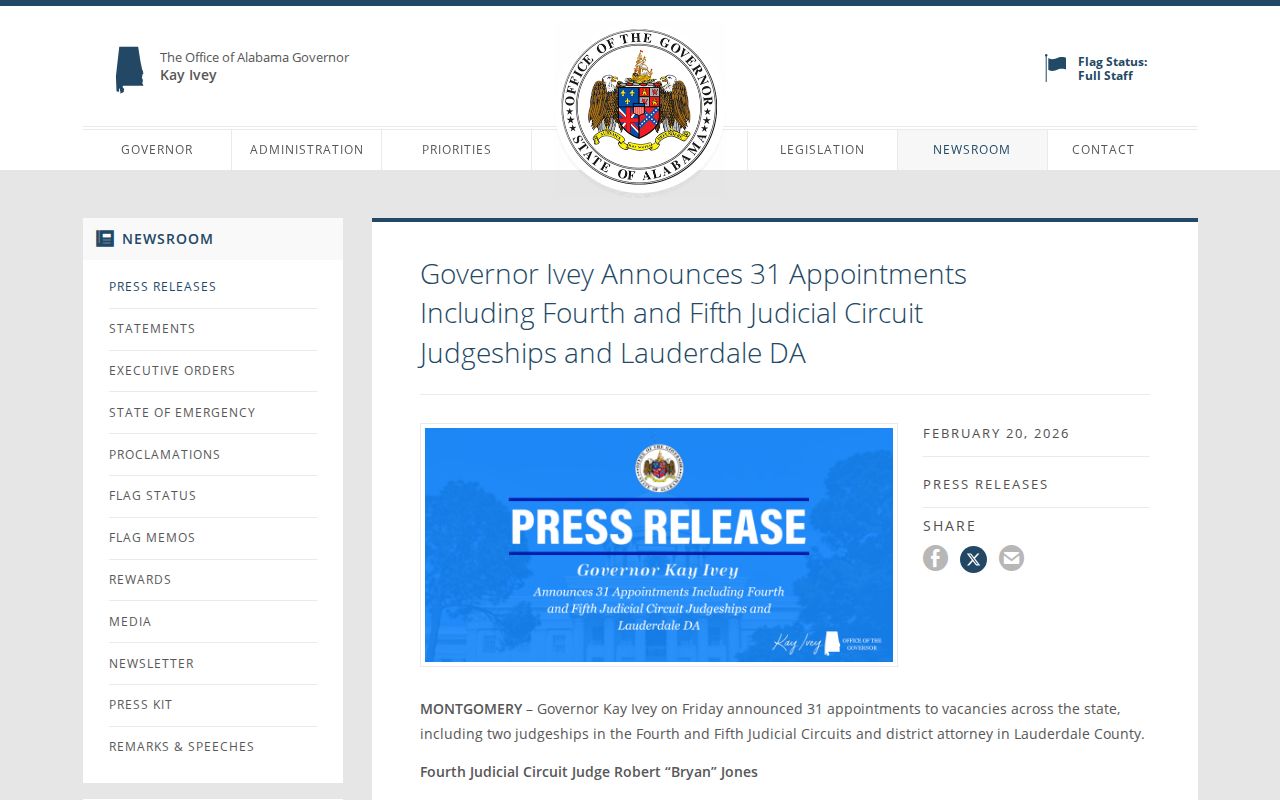
The appointment notice resolves the conflict between current DA status and legacy office-site branding.
Sealed vs Expunged Criminal Records
Sealing and expungement both restrict public access, but they are not the same thing. A sealed record is hidden from ordinary public view by law or court order. An expunged record is restricted through the Alabama expungement process for qualifying charges or convictions. Expungement is filed in Circuit Court in the county where the charge was filed and depends on the conditions in Alabama expungement law.
| Point | Sealed | Expunged |
|---|---|---|
| Public view | Not open to general public access. | Public access is limited after a granted expungement order. |
| How it happens | By statute, court rule, or court order. | By petition in Circuit Court using the required AOC form and attachments. |
| Typical examples | Juvenile records, adoption records, commitments, protected family data, and sealed filings. | Qualifying criminal charges or convictions under Alabama expungement statutes. |
| Important limit | Authorized parties or agencies may still access some sealed material. | Expungement limits public access but does not erase every law-enforcement, court, or legally permitted use. |
Access to Lauderdale Criminal Records
Most adult criminal case information in Lauderdale County starts with Alacourt ACCESS or the Clerk of Court. Alabama public-records law supports access to public records, but criminal court files remain subject to court rules, sealed orders, juvenile confidentiality, expungement, redaction, and statutory limits. For a certified copy, disposition, or case-action summary, use the Clerk of Court rather than a screen view.
Key access point: A public charge entry does not prove conviction; verify disposition and sentence before relying on a criminal record.
Juvenile criminal records are especially limited. AOC juvenile forms identify juvenile records as confidential under Alabama juvenile law, and access may depend on party status, attorney status, consent, statute, or court order. Public defender information was not located as a standalone local office page; the research supports using the court handling the criminal case for appointed-counsel and hardship questions.
Restricted Lauderdale Criminal Records
Restricted criminal court records can include juvenile files, sealed cases, expunged cases, adoption or commitment-related records, protected personal identifiers, financial account data, minor information, medical information, and protected addresses. Newly filed or corrected matters may also lag in the online system. If a record is missing from Alacourt or the docket list, that does not prove the case does not exist. It may mean the file is restricted, not imaged, too new, older, or held by a different court.
The AOC expungement process requires careful service on record holders, including agencies such as the District Attorney, sheriff, police, ALEA, circuit clerk, district clerk, municipal clerk, or other agency holding the record. Records held by parties not served may not be successfully expunged or may be delayed. That service requirement is one reason the full criminal court record, arrest record, law-enforcement record, and statewide criminal-history record should be treated as related but separate files.