
Lauderdale County Arrest Records
Lauderdale County arrest records are not the same as court charge records. The arrest side starts with a law-enforcement event, booking, jail intake, bond, or detention inquiry. The court side begins when a complaint, information, indictment, or other charging paper reaches the court and creates a case that the Clerk of Court can track. A person can be arrested and later not charged, charged with a different offense, or have a charge dismissed after the court case opens.
The official sheriff and county sources reviewed did not publish a public Lauderdale County Alabama web jail roster or arrest roster. That means booking or custody checks should use the Sheriff and Detention Center fallback, while formal court charges should be checked through Alacourt, the Clerk of Court, or the court that holds the case. The full criminal case file and final outcome are handled in Lauderdale County criminal court records.
Find Lauderdale Arrest Records and Charges
For court charges after arrest, start with the court case, not the jail search. Alacourt ACCESS / Just One Look is the paid path for most public Circuit Court and District Court criminal case detail. The case detail can include basic case information, court action, case status, setting dates, party information, financial history, and a detailed case-action summary. Use the LOC=58 docket list only for setting-date checks, because it is not a full charge detail report.
- Confirm whether the matter is a Circuit Court felony, District Court misdemeanor, state traffic case, municipal case, juvenile case, or federal case.
- Search Alacourt by case number when a citation, bond document, notice, warrant, or case paper gives the number.
- Use a defendant-name search when no case number is available, knowing that paid no-match searches still count.
- Open the case detail and read each charge or count, current status, disposition, and case-action summary.
- Call the Clerk of Court, municipal court, sheriff, or detention center when the online case is missing or the arrest side needs confirmation.
The state prison search is not a county arrest roster. The ADOC inmate search is the successful manifest source for currently incarcerated state inmates, and ADOC states historical data is not available online.
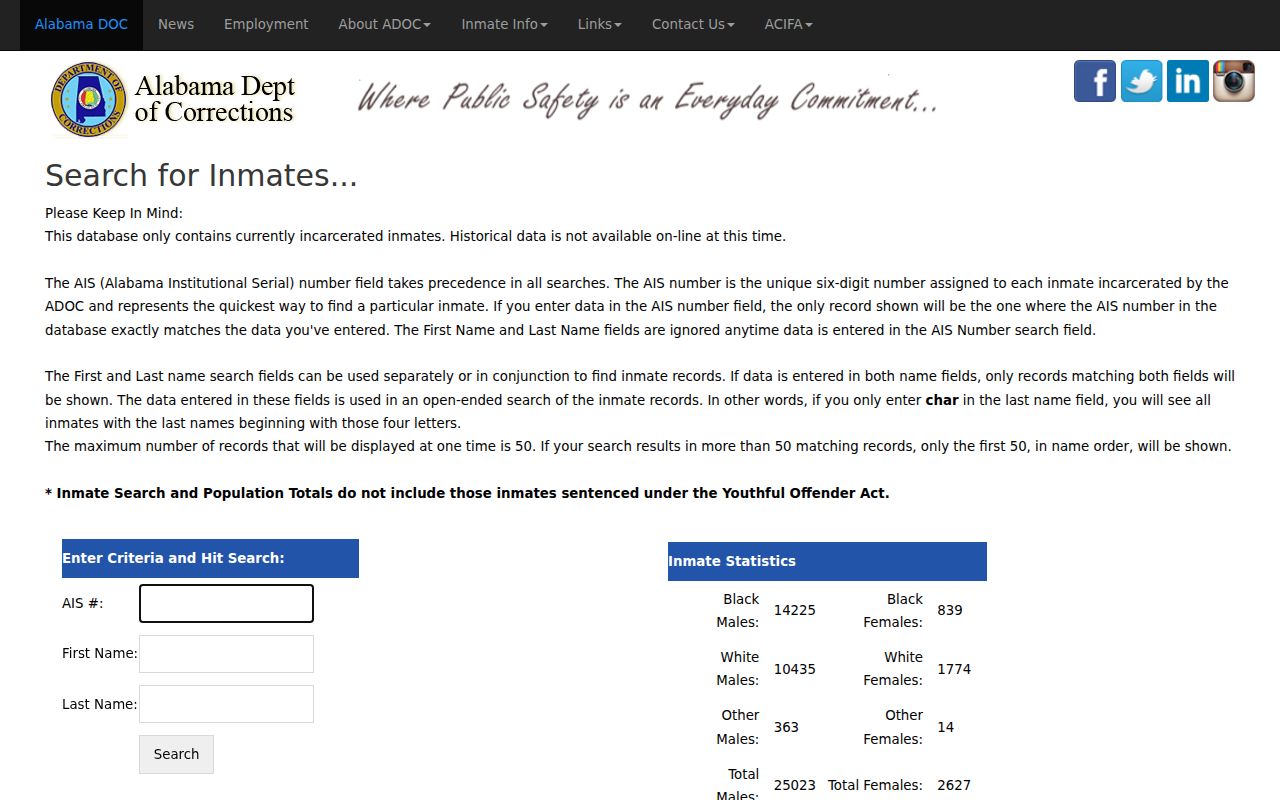
That state-prison distinction matters because pretrial county jail or recent arrest questions still belong with Lauderdale County officials.
Arrest Record vs Court Charge
An arrest record is tied to law enforcement and custody. A court charge is tied to prosecution and the court case. They can overlap, but they are separate records with separate custodians. The sheriff or detention center may confirm custody or booking questions, while the Clerk of Court confirms court charges, docket settings, dispositions, and certified case records.
| Point | Arrest / booking side | Court charge side |
|---|---|---|
| Custodian | Sheriff, detention center, or arresting agency. | Clerk of Court, District Court, Circuit Court, or municipal court. |
| Main content | Arrest event, custody status, booking, bond, and jail routing if available. | Complaint, information, indictment, charge list, case status, disposition, and sentence. |
| Online gap | No official Lauderdale County Alabama web jail roster was located. | Public adult case detail may be available through paid Alacourt access. |
| Best use | Confirm current custody or recent booking questions. | Verify filed charges, amended charges, dismissed counts, and convictions. |
Charging Documents After Arrest
Charges after arrest are filed through legal documents that move the accusation into court. The research identifies complaint, information, and indictment as key terms in the court-record glossary. A complaint starts many civil or misdemeanor matters. An information is a prosecutor-filed charging document where allowed. An indictment is a grand-jury felony charging document. The type of document can help explain why a case appears in District Court, Circuit Court, or a later felony path.
| Document | Filed by | Common role | What to check |
|---|---|---|---|
| Complaint | Officer, complainant, or prosecutor depending on case type. | Starts many misdemeanor or lower-court criminal matters. | Charge, defendant, court, case number, and first setting. |
| Information | Prosecutor. | Prosecutor-filed charging paper where allowed by law. | Formal charge language, counts, amendments, and plea history. |
| Indictment | Grand jury. | Felony charging document for serious criminal cases. | Counts, offense language, arraignment, bond, and Circuit Court routing. |
Lauderdale County DA Charging Role
The District Attorney's office is central to court charges after arrest. The DA office site states that it prosecutes felonies, misdemeanors, traffic offenses, and juvenile cases in Lauderdale County, Alabama, and works with DHR on child support. The current-source note from the Governor's February 2026 announcement names Angela King Hamilton as District Attorney for the 11th Judicial Circuit serving Lauderdale County, even though the office domain may still show older Chris Connolly branding.
Prosecutor decisions can change what appears in a charge record. Charges may be filed, amended, reduced, added, dismissed, or resolved through plea negotiations. The arresting agency may list an initial allegation, but the court case should be checked to see what the prosecutor actually filed and how the judge disposed of each count. Juvenile prosecutions have separate confidentiality limits and should not be treated as ordinary public charge records.
Lauderdale Charge Status Terms
Charge status is the best way to avoid reading too much into an arrest. A charge can be pending while the case is active, amended when the prosecutor changes the allegation, reduced when the severity or offense changes, dismissed when the court removes the charge, or resolved through a plea or verdict. One arrest can produce several counts, and each count can have a different result.
| Status | What It Means |
|---|---|
| Pending | The charge remains active and has not reached final disposition. |
| Amended | The original charge was changed by prosecutor action or court order. |
| Reduced | The charge was changed to a less serious offense or lower count. |
| Dismissed | The charge was ended by court action and did not result in conviction on that count. |
| Nolle prosequi | The prosecutor declined to proceed on the charge, subject to the legal effect of the court entry. |
| Convicted | The charge resulted in a guilty plea, verdict, or other recorded finding of guilt. |
Charges vs Convictions
Being charged is not the same as being convicted. Lauderdale County arrest records may point to why a person was taken into custody, and court charge records may show what was filed after the arrest. The conviction question is answered by the disposition and sentence. A public charge should be read as an allegation until the court record shows a guilty plea, verdict, or other conviction result.
| Point | Charge | Conviction |
|---|---|---|
| Stage | Accusation filed in court. | Final guilt outcome for a count. |
| Can change | Yes, it may be amended, reduced, added, or dismissed. | Changes usually require later court action, appeal, correction, or expungement. |
| Where to verify | Charging document and charge list. | Disposition, sentence, judgment, and case-action summary. |
| Record risk | Can be mistaken for guilt if read alone. | Still must be matched to the correct person and case. |
Sheriff and Jail Fallback
No official Lauderdale County Alabama public jail roster or arrest roster was located in the sheriff, county, or AOC sources reviewed. Third-party roster pages and Lauderdale County Mississippi results were excluded. The official fallback is the Lauderdale County Sheriff's Office, the Detention Center phone line, and the court or agency that owns the record. The Sheriff homepage and app listings support crime reporting, tips, alerts, and public safety information, but the official store text did not confirm an app-only inmate or warrant lookup.
The ADOC contact and public-records page is the successful manifest source for state correctional record routing, not county jail custody.
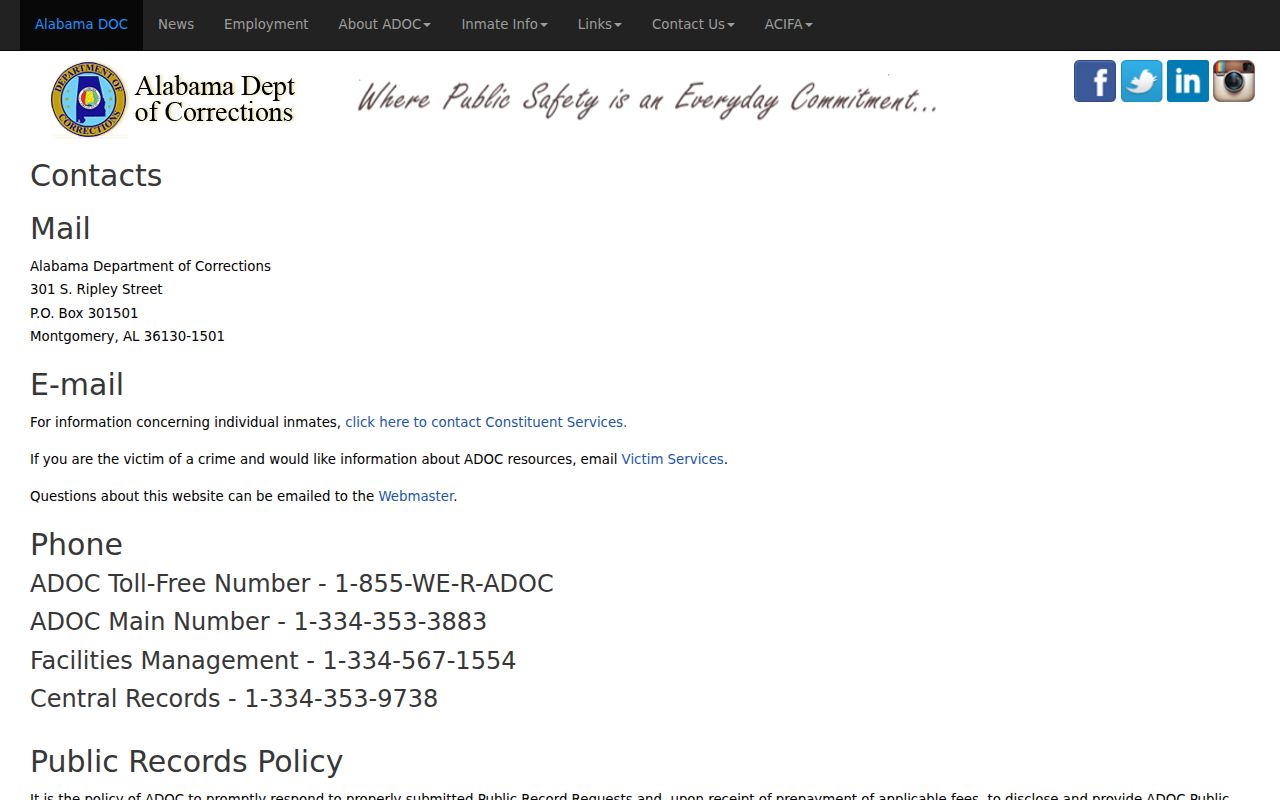
That source reinforces the split between ADOC state-prison records and Lauderdale County sheriff or detention-center records.
Lauderdale County Sheriff's Office
200 South Court Street
Florence, AL 35630
(256) 760-5757
Mailing address: P.O. Box 1710, Florence, AL 35631
Lauderdale County Detention Center
563 South Seminary Street
Florence, AL 35630
(256) 760-5771
Use for county jail custody and booking fallback questions.
Statewide Charge Record Limits
Statewide systems can help with related records, but they do not replace the Lauderdale County court charge file. ADOC inmate search covers currently incarcerated state inmates and excludes historical online data. The Alabama Victim Notification System covers offenders convicted in Alabama and sentenced to ADOC custody, and it directs pretrial case questions back to the sheriff in the county where the crime occurred. ALEA driver and crash portals are separate from criminal court charge records.
Alabama Victim Notification System is the successful manifest source explaining the state-prison notification scope.
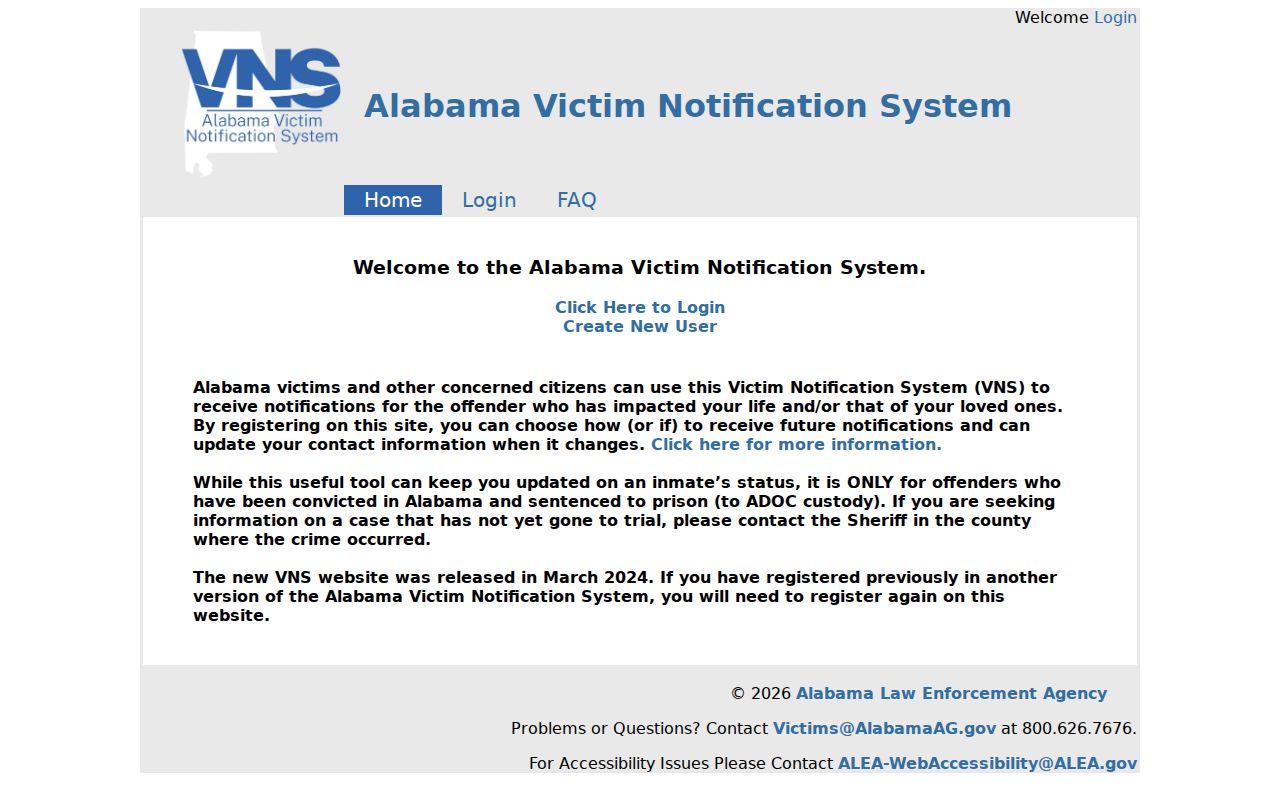
The victim notification source is useful because it separates sentenced ADOC offenders from pretrial county jail or court-charge questions.
ALEA's driver record and crash portal is the successful manifest source for driver and crash records.

ALEA driver and crash records may relate to traffic incidents, but they are not the court's formal charge file.
Sealed vs Expunged Charges
Sealed and expunged charge records are restricted from ordinary public access in different ways. Juvenile information is confidential under Alabama law unless access is authorized. Sealed files may be hidden by statute or court order. Expungement is a petition process in Circuit Court for qualifying charges or convictions. It limits public access to records held by served agencies, but it does not erase every lawful court, law-enforcement, or statutory use.
| Point | Sealed | Expunged |
|---|---|---|
| Public access | Restricted by statute, rule, or court order. | Restricted after a granted expungement order. |
| Common context | Juvenile records, protected family data, commitments, or sealed filings. | Qualifying criminal charges or convictions under Alabama expungement law. |
| How to request | Access usually requires legal authority, party status, consent, or court order. | File the AOC petition in Circuit Court in the county where the charge was filed. |
| Limit | Authorized agencies may still see some sealed material. | Agencies not served may keep records or delay expungement processing. |
Lauderdale Charge Expungement Requirements
The Alabama AOC CR-65 Petition for Expungement of Records was revised in 10/2024 and is the current research source for the statewide form requirements. A petitioner must identify the underlying charge or conviction, attach a certified arrest record or certified disposition or case-action summary, attach a certified official criminal record from ALEA, provide a sworn statement, and serve the required record-holding agencies. The administrative filing fee is $500 unless the court grants hardship relief.
Service is not a minor step. The form warns that records held by parties not served may not be successfully expunged or may be delayed. Potential agencies include the District Attorney, municipal chief of police, Sheriff, State Troopers or ALEA, the court clerk, a municipal clerk, or another record holder. That is why arrest records, court charges, and criminal-history files must be tracked separately when preparing an expungement request.
Important: Expungement eligibility depends on the exact charge, disposition, timing, and statutory conditions in Alabama law.
Restricted Charge Records
Restricted charge records include juvenile charges, sealed files, expunged records, adoption or commitment-related material, and records with protected identifiers. Ongoing investigations may also have information that is not open through a public court search. If an online search does not show a charge, that result should not be treated as proof that no arrest, no charge, or no restricted case exists.
For the most reliable answer, match the question to the custodian. The sheriff or detention center handles custody and recent booking fallback questions. The Clerk of Court handles Circuit Court and District Court charge records, case-action summaries, docket settings, and certified copies. A municipal court handles city cases. ALEA and ADOC handle their own statewide records. Each system can tell part of the story, but the court disposition is the key field for whether a charge became a conviction.